Scheduler
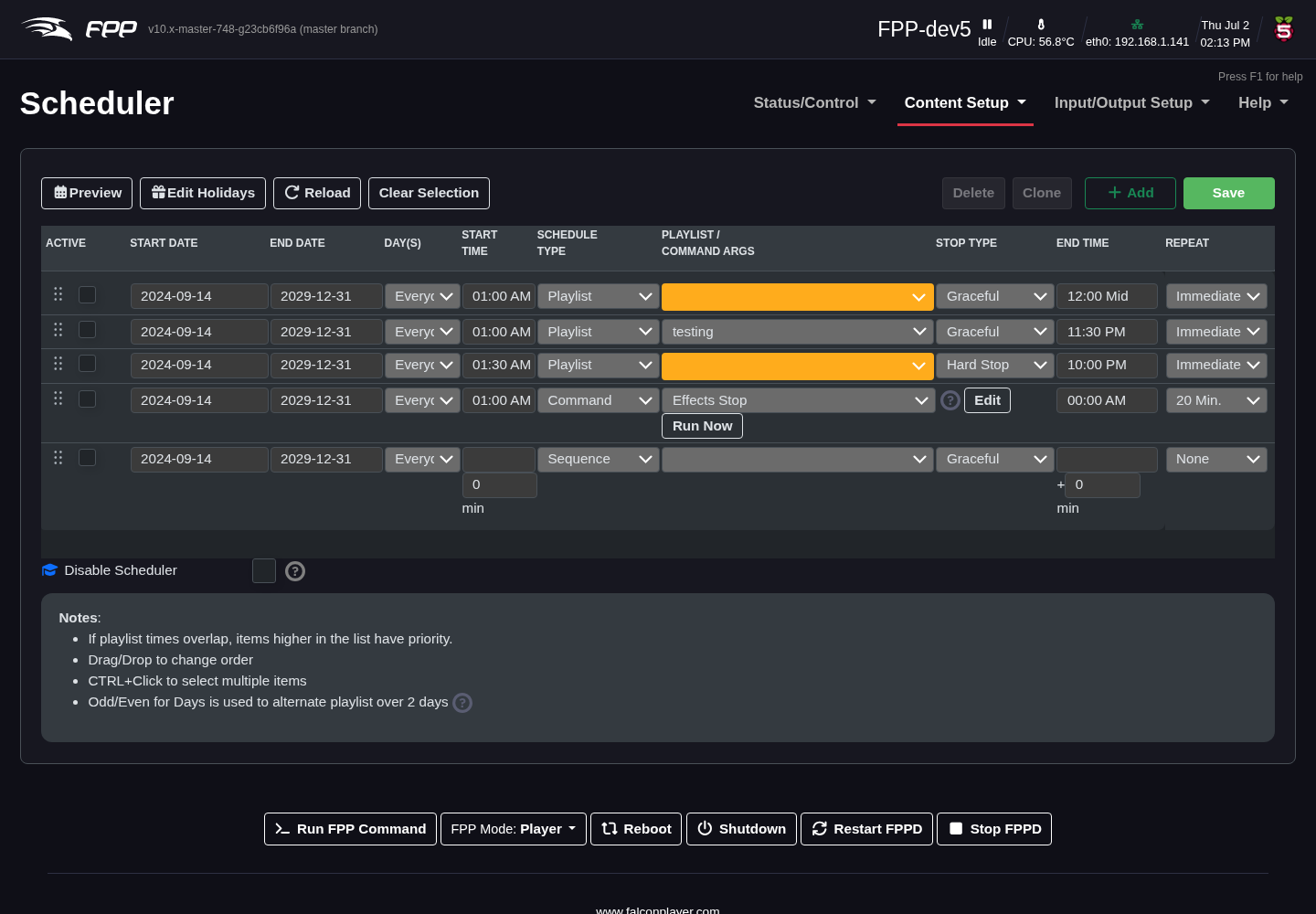
The Scheduler runs predefined playlists (or FPP Commands, or single sequences) automatically on a preset schedule — the heart of an unattended show. Open Content Setup → Scheduler.
Note
The scheduler is normally used only on a device in Player mode, not on remotes (which take their instructions from a player) — though you can schedule FPP Commands only on a remote for special cases.
You can have multiple playlists for different days, holidays, or even different times of the same day. The scheduler supports priority scheduling: an entry higher in the list has a higher priority and preempts lower ones.
Important
For schedules to start at the right time, your time settings must be correct — including Latitude/Longitude for sun‑based times (see FPP Settings → Localization).
Understanding the schedule (Preview)
Preview shows a graphical view of the saved schedule for the week, which helps identify problems. Each entry is colour‑coded by start/stop time and stop mode. If the colours are not in pairs it may indicate a problem — but not always, if you are using priorities. Items skipped due to a priority conflict are marked in red; if a higher‑priority schedule ends while a lower‑priority one should still be playing, the lower‑priority schedule starts when the higher one finishes. Hover over a question mark for a summary of that entry.
Calendar View
New in FPP 10, Calendar View shows the schedule as a familiar calendar rather than a week strip — useful for checking a whole season at a glance, or confirming that a holiday entry lands on the right date. Open it from the Calendar View button on the Scheduler page, or from the Preview drop‑down on the Status page.
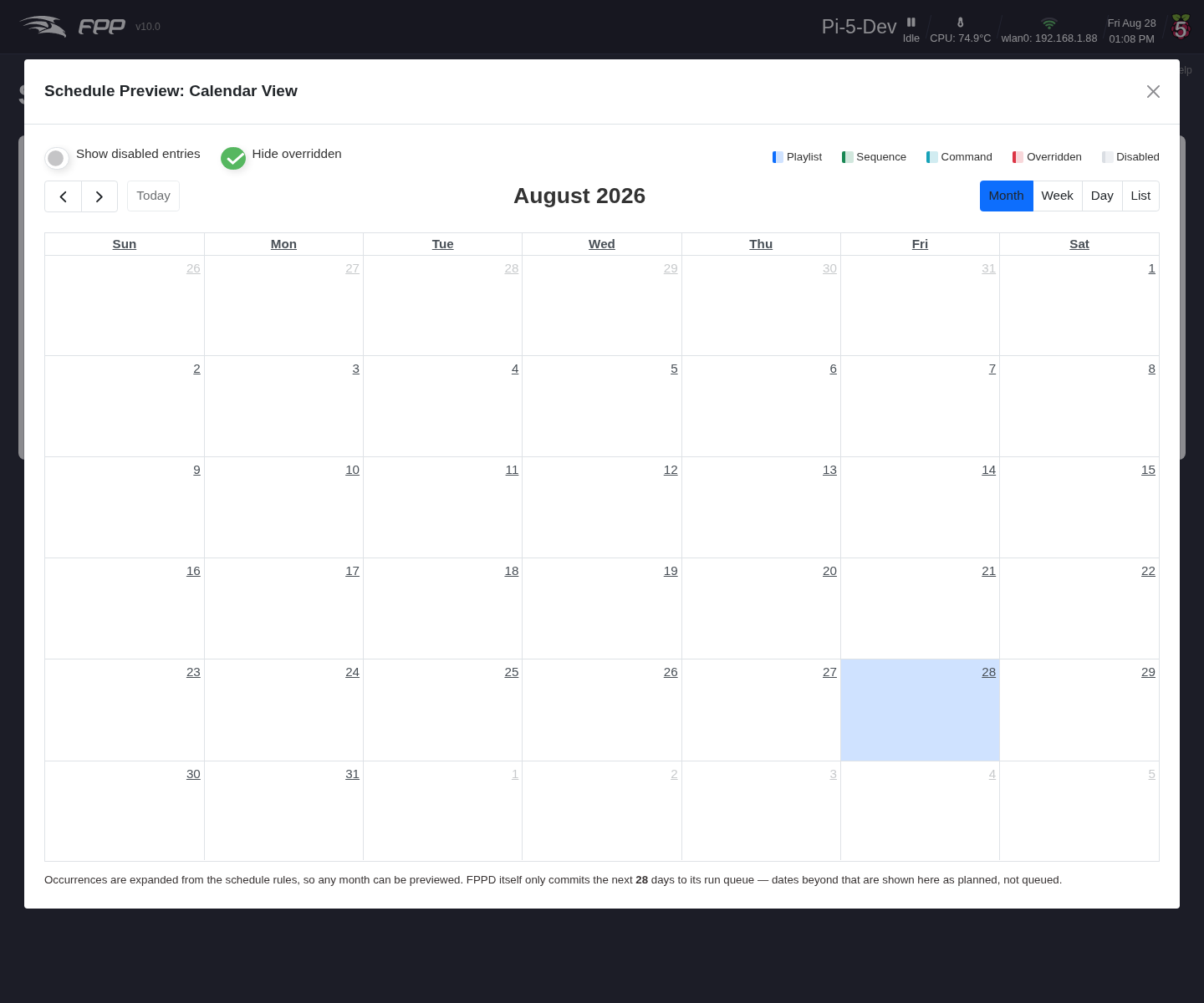
- Switch between Month, Week, Day and List views with the buttons at the top right, and move around with the ‹ / › arrows and Today.
- Entries are colour‑coded by type — Playlist, Sequence, Command — plus Overridden (an entry a higher‑priority one preempts) and Disabled.
- Show disabled entries adds inactive entries to the view; Hide overridden (on by default) removes the ones that will not actually run, so you see what will really happen.
Note
The calendar expands occurrences from your schedule rules, so you can preview any month, however far ahead. FPPD itself only commits the next 28 days to its run queue — dates beyond that are shown as planned, not queued.
Page controls
- Reload – reload the saved schedule (discarding unsaved changes).
- Clear Selection – deselect any selected rows.
- Delete – delete selected rows (not final until you Save).
- Clone – copy selected rows to the bottom of the list.
- Edit Holidays – opens the Edit User-Defined Holidays dialog, where you define your own holidays in addition to the standard ones that come from your configured Locale. They can then be picked by name in an entry's Start/End Date.
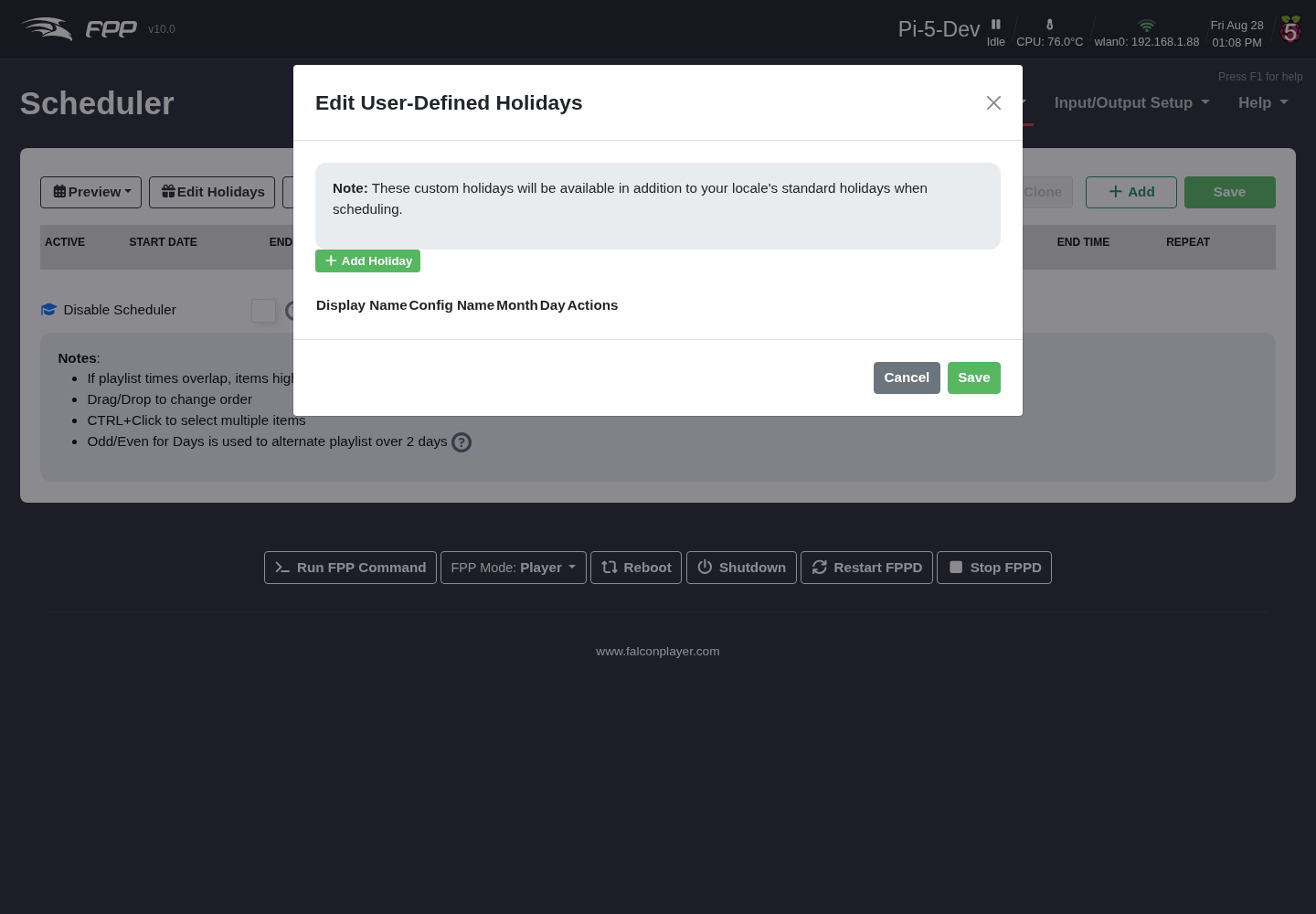
+ Add Holiday adds a row, where you give the holiday a Display Name (what you see in the date lists), a Config Name (the identifier FPP stores), and the Month and Day it falls on. Save stores them. - Save – must be clicked to store any additions or changes.
Note
FPP checks each entry as it is shown. An FPP Command whose command no longer exists, or whose arguments name a playlist, sequence, media file, effect, script or preset that is missing, gets a warning icon listing what is wrong — and a scheduled playlist that has problems of its own is flagged too. The same command check runs on the Command Presets, GPIO Inputs and Recurring Tasks pages. Flagged entries can still be saved.
- Add – create a new entry, then fill in its columns.
Schedule entry fields
- Active – enable or disable the entry (e.g. prepare a future entry without running it yet).
- Start Date – when the playlist begins playing; can be far in the past (it plays at the next matching time/day). With a Holiday List configured (see FPP Settings → Localization) you can pick holidays by name. A holiday date gets a day offset box beside it (−366 to 366 days), so Thanksgiving −7 or Christmas +2 works out the right date every year.
- End Date – the last day it plays (it still starts on this date); can be far in the future. Holidays by name, with their own day offset, are supported here too. The Schedule Preview shows the offset in the holiday's label.
- Day(s) – any combination of days; common combinations are in the drop‑down, or choose Day Mask and tick specific days.
- Start Time – when to begin, in your configured time format (defaults to 24‑hour). Half‑hour times are suggested, but you can enter any time. You can also choose Dawn, Sunrise, Sunset or Dusk to follow local daylight (requires Latitude/Longitude).
- Schedule Type – Playlist, a single Sequence, or an FPP Command.
- Playlist/Command Args – the playlist or command to run. (An FPP Command has no end time unless set to repeat — it simply triggers at the start time.)
- End Time – when to end; a playing sequence ends according to the Stop Type. Sun‑based end times are supported. If the schedule runs past midnight, set the end time you want and FPP will understand it is on the next day.
- Repeat – three types:
- None – play once.
- Immediate – restart the Main playlist from the beginning each time it finishes, repeating until the end date/time. Useful when a previous playlist might still be finishing (e.g. a Graceful Stop) when this one is due to start.
- Timed – run once every X minutes (each iteration includes Lead In, Main and Lead Out). The preview shows multiple instances from the start time, every X minutes, up to the end time.
Stop Type
Each entry's Stop Type controls how a running item ends at the end time — Graceful (finish the current item), Graceful after loop, or Hard Stop (stop immediately).
Tip
A common pattern is a nightly entry from Sunset to a fixed time with a Graceful stop (so songs are not cut off), plus a Command entry a few minutes earlier to switch on power or run a pre‑show.