MultiSync
The MultiSync page (Status/Control → MultiSync) is where you set up a MultiSync/Remote layout, but it has evolved into a much more useful interface for all of your FPP devices and most controllers. A MultiSync/Remote layout can eliminate the Ethernet cabling between your FPPs/controllers and allows widespread model placement; one FPP player keeps any number of FPP remotes playing in perfect time by broadcasting small timing packets. You can also view status and system information for every device, and upgrade them all from one interface.
You can use MultiSync on a wired setup too, to save network traffic, though the benefit there is usually small. For deeper background on layout and function, see Advanced Options → MultiSync/Remote.
Note
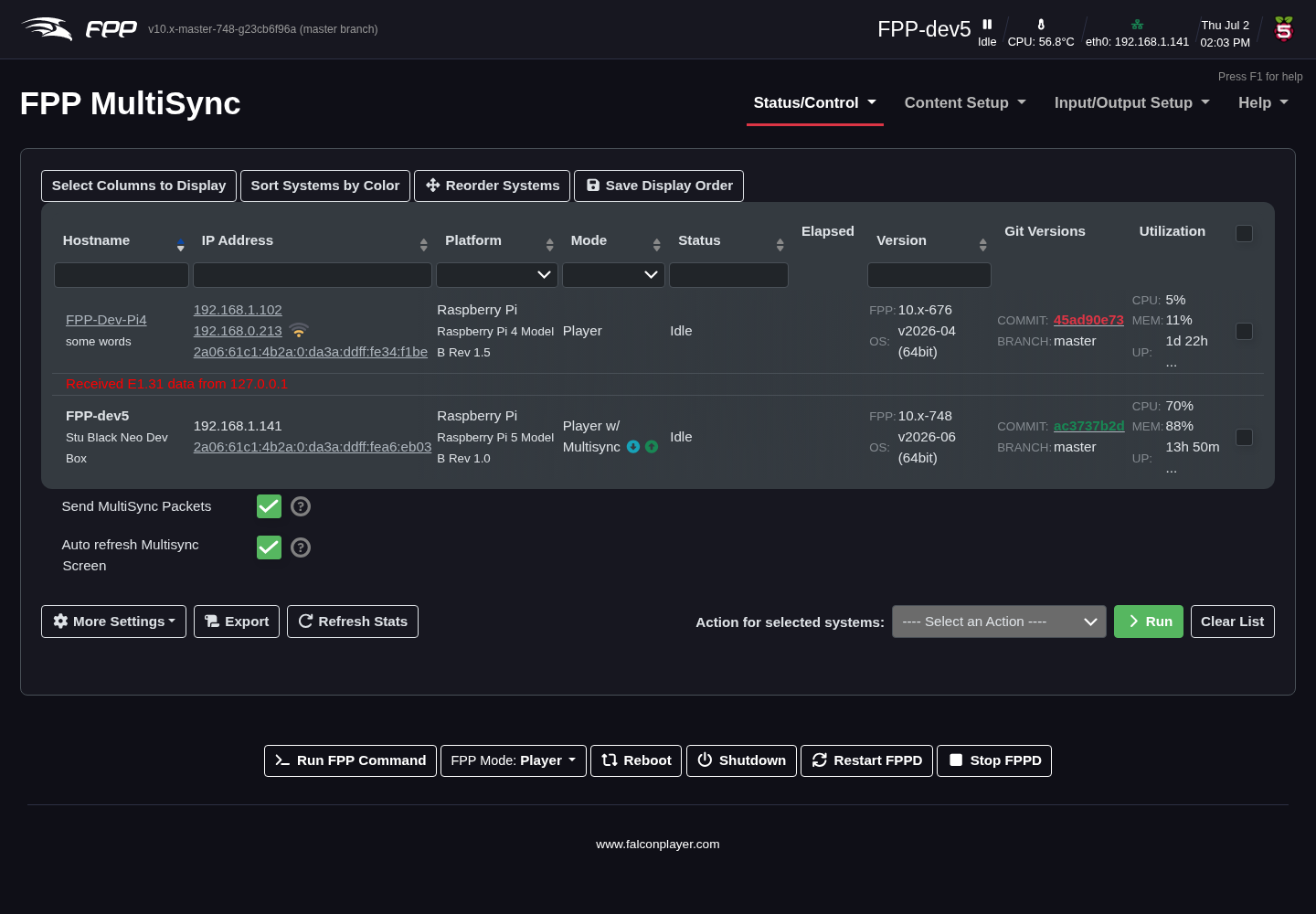
The MultiSync page appears differently depending on your UI Level and the device's mode. It also shows the UI header colours for easy identification. (In the example image, several errors are shown deliberately to illustrate potential problems — this is not normal.)
The systems table
FPP automatically discovers other FPP instances on the network. Use Select Columns to Display to choose columns, Sort Systems by Color to group by header colour, and the header fields/arrows to filter and sort. Columns include:
- Hostname – every discovered device (the current device is in bold). If two devices share a host name the display may be inaccurate.
- IP Address – all configured addresses for each device, as hyperlinks to that device. If a remote has a Wi‑Fi connection, a checkbox appears next to the Wi‑Fi icon to configure it for Unicast Sync. Multicast sync is recommended when your network supports IP Multicast and IGMP Snooping; if it does not, or you get dropped/unreliable connections, set your remotes to Unicast and disable "Send MultiSync to all remotes via Multicast".
- Platform – the SBC model and other information.
- Mode – the FPP mode each device is running.
- Status – the current status; if playing, the sequence name.
- Elapsed – elapsed time of the playing sequence on player and remotes, or an indication that the device is bridging.
- Version – the FPP branch, version and OS installed.
- Git Version – software status: red = an upgrade is available, green = up to date, black = the device could not report (usually a network/DNS configuration error).
Display and sending options
- Send MultiSync Packets (Player mode) – send MultiSync packets to devices configured as remotes.
- Auto Refresh stats of FPP Systems – refresh the screen every 2 seconds.
- More Settings – additional display and sending options:
- Send MultiSync to all Remotes via Multicast (Player, with Send enabled) – send via IP Multicast.
- Send MultiSync to all Remotes via Broadcast (Player) – send via network broadcast; helpful on networks without IP Multicast / IGMP Snooping.
- MultiSync Unicast Discovery IPs (CSV list) – for instances/controllers not found by normal discovery. (Advanced.)
- HTTP Discovery IPs & subnets – add devices on a different subnet so they appear on the MultiSync page. (Advanced.)
- Hide 10.x/8, 172.x/12, 192.168.x/16 Subnets – hide private‑range subnets from the list, useful when a device is on both a show network and your home network and you only want to see one. (Developer‑oriented.)
- Export – download a spreadsheet of all connected devices and their stats at the time of export.
Note
At the time of writing, Falcon controllers in remote mode do not support Multicast (expected in a future controller update), and not all home networking equipment supports Multicast.
Actions on selected systems
Tick one or more devices in the right‑hand column, choose an Action, and click Run to apply it to all of them at once:
- Upgrade FPP – upgrade software on any or all devices simultaneously (red = out of date, green = up to date, black = could not determine, usually a DNS problem). A progress screen is shown; afterwards you can Reboot or Restart FPPD.
- Restart FPPD – restart the FPP software without a full OS reboot.
- Reboot / Shutdown – full OS reboot or shutdown of the selected devices.
- Copy Show Files – copy show files from this device to others. You cannot
pick individual files; all files of the selected type are copied. Take care
with sequences, as some are only compatible with the device they were built for.
- Compress FSEQ Files – compress FSEQ files before sending, mainly for older V1 FSEQ files (newer V2 files are usually already compressed).
Note:
rsyncmust be enabled on any remote you send files to.
- Copy OS Upgrade Files – copy
.fpposOS‑upgrade files to other devices; only files appropriate to each platform are copied (Pi files won't go to BB systems, and vice versa).rsyncmust be enabled on the target. - Set to Player / Set to Remote – change the mode of the selected devices.
- Add as Proxy – configure this device to act as a Proxy Host for the selected device (see Backup, Restore and Proxies → Proxy Settings).
Note
FPP Connect in xLights is a more robust way to upload files to your FPP devices — it can upload in a sparse format that greatly reduces file size, and can also configure inputs, outputs and other settings.