The Status Page
The Status/Control menu holds the day‑to‑day settings, status reports and playback control of your FPP device. Its first entry — and the default page that loads when you log into FPP — is the Status Page. Depending on which mode FPP is running in, Player or Remote, the screen looks a little different.
Note
Depending on your FPP device, hardware and UI Level, your options may differ slightly from those shown here.
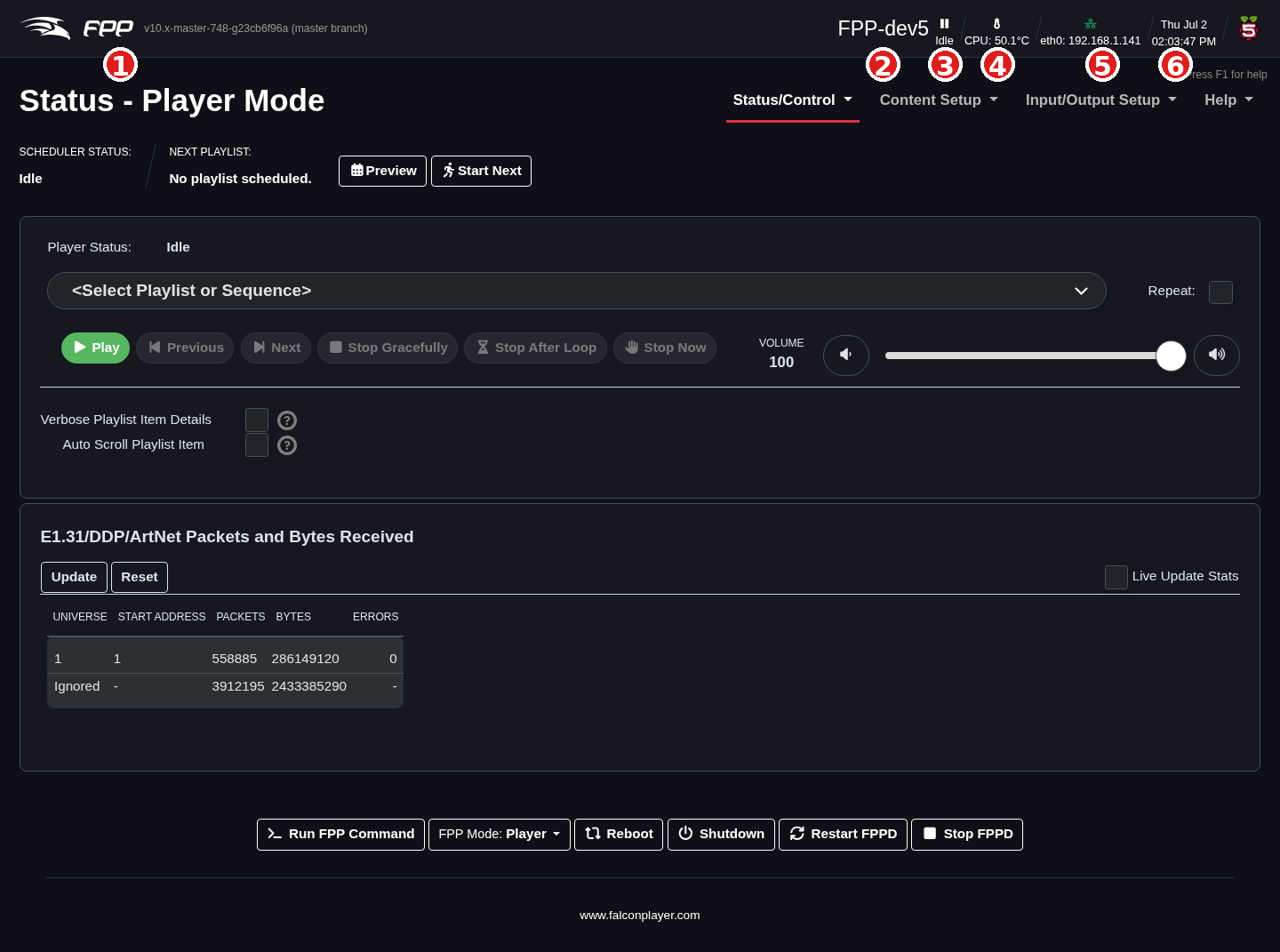
The header bar
The header appears on every page and gives at‑a‑glance status. The numbered callouts above correspond to:
- Logo and version – the FPP logo with the version number beside it; the version links to the System Upgrade page.
- Host name – the device's configured host name.
- Player state – whether FPP is idle or playing.
- Sensors – readings such as CPU temperature.
- IP addresses – the device's active network addresses.
- Time – the device's current date and time.
Press F1 for help (top right) opens context‑sensitive help for the current page.
Player Status Page
There are several sections on the Player Status page.
Scheduler Status
This section shows the status of your Scheduler and options to control a playlist that is playing.
- Current Playlist – shows the currently playing playlist. If nothing is playing it shows Idle. If the playlist was started by hand it shows (Manually Started) after the name.
- Playlist time extension – you can manually extend (or reduce) a scheduled playlist that is running. Click Extend to change the scheduled end time in minutes (use a negative number to shorten it); a second button extends in 5‑minute increments. You can extend the end time by at most 720 minutes (12 hours) or reduce it by 360 minutes (3 hours). Once a playlist has reached its scheduled end time this option is no longer available, even if a song is still finishing (a graceful shutdown).
- Playlist Started at – the time the scheduled show started.
- Stop Type – the stop strategy for the scheduled playlist that is currently playing, and the time it is scheduled to stop.
- Next Playlist – the next scheduled playlist, with the start time and day it will begin.
- Preview – shows a graphical representation of your schedule for the next 4 weeks (extendable via an advanced setting in FPP Settings). A good way to verify your schedule.
- Start Next – ends the current playlist immediately and starts the next scheduled playlist. That playlist still ends at its normally scheduled time.
- Abnormal Conditions – if FPP detects conditions that can affect performance, the messages are listed here. These almost always need to be remedied for your show to run properly; see the Help and Troubleshooting chapter for common messages and fixes.
Player Status
- Player Status – lists the sequence/song currently playing. It also shows a "breadcrumb" when an inserted playlist is playing — for example when using Remote Falcon, or an FPP Command such as a push‑button that inserts a playlist into your normal playlist.
- Playlist / Sequence Selector – shows the playlist that is playing; otherwise use it to select a playlist, an individual sequence, or an individual media file to play manually.
- Player controls – control the currently queued playlist: a. Play – play the queued playlist from the selected element. If Repeat is ticked it keeps playing until stopped manually or a scheduled playlist starts. b. Previous – step to the previous playlist item. c. Next – step to the next playlist item. d. Stop Gracefully – finish the current song, then stop. e. Stop After Loop – stop when the end of the current playlist loop is reached. f. Stop Now – stop immediately.
- Repeat – if ticked when you manually start a playlist or sequence, it keeps playing until stopped manually.
- Volume – controls the output volume for the currently playing sequence. Useful for setting the level fed to an FM transmitter or external speakers.
- Song Status – shows how long the current song has been playing and how much time remains; it also indicates if the playlist is set to random order.
If nothing is playing the status is Idle. It also indicates when a playlist is shutting down gracefully (finishing the song, then stopping).
Two display options refine the view during playback:
- Verbose Playlist Item Details – show much more information for each playlist item (helpful for seeing all the arguments of scripts or FPP Commands).
- Auto Scroll Playlist Item – with many items, keep the currently playing item visible in the window.
Playlist Details
This section shows the details of the currently selected playlist (see the Playlists chapter for more).
- Lead In – any Lead In items, with total items and per‑item durations.
- Playlist Status – how long the current item has been playing and how much time is left.
- Main Playlist – an overview of the Main playlist: number of items and total duration.
- Playlist Details – every item in the Main playlist, showing sequence name and associated audio file; the currently playing item is highlighted.
- Lead Out – any Lead Out items, with total items and per‑item durations.
Remote Mode Status Page
When FPP Mode is set to Remote, the Status page instead reflects synchronisation with a player:
- Abnormal Conditions – as above, any conditions that need remedying.
- Remote Status – the Remote‑mode sync status: whether it is actively syncing to a player, elapsed time for the current sequence, and time remaining.
- Player IP – which device is sending the sync packets, with its IP address (a hyperlink to that device) and host name.
- Sequence Filename – the currently playing sequence.
- Media Filename – the media (audio/video) file being played, if any.
- Volume – controls the volume of media played on this remote.
- MultiSync Packet Counts – all of the sync messages received from other devices. Live Update Stats refreshes every second; Update refreshes once; Reset clears the history. Columns include: a. Host – IP addresses of devices that have communicated with this one. b. Last Received – the last day/time communication was received. c. Sequence Sync / Media Sync – stats for sequence and media sync messages. d. Blank Data – stats for blanking data received. e. Ping – devices that have pinged this remote. f. Plugin / FPP Cmd – stats for plugin and FPP‑command messages. g. Errors – any errors encountered.
Channel Inputs Status Section
If you have Channel Inputs enabled (see the Channel Inputs chapter) and FPP has received input data, an additional panel appears in the lower part of the Status page — the E1.31 / DDP / ArtNet Packets and Bytes Received table. It shows the configured universes / DDP data and packet statistics per row: Universe, Start Address, Packets, Bytes and Errors. Live Update Stats refreshes every second, Update refreshes once, and Reset clears the counters.
Current Monitor
If your FPP device has eFuses (electronic fuses) and supports current‑monitoring, a Current Monitor tab is available under Status/Control. It shows the measured current draw per port, which is useful for spotting shorts and balancing power. (This requires cape hardware that reports current monitoring — see the Capes appendix.)
Bottom action bar
The buttons along the bottom of the page apply to the whole device:
- Run FPP Command – run any FPP command manually (the same commands available to presets, the scheduler and the API — see Commands, Effects and Testing).
- FPP Mode – switch the device between Player, Remote and other modes. Changing mode restarts the FPP daemon.
- Reboot / Shutdown – restart or safely power down the device.
- Restart FPPD – restart just the FPP daemon (needed after some changes).
- Stop FPPD – stop the FPP daemon.
Note
When a change requires it, a banner appears prompting you to Restart FPPD or Reboot. Output does not resume until the requested action is done.